Sunday, October 28, 2012

Yatsuhashi Halloween


Where did the month go? Suddenly it's almost Halloween, which seems to be getting more popular  in Japan, every year.

I've been thinking about a Kyoto post for a while - but Kyoto is overwhelming. I mean, there are so many fabulous specialties and there's a photo op around every corner. I will get to it soon! But in the meantime, I thought this Kyoto specialty was perfect for Halloween.


Soft and powdery deliciousness.

Inside is black sesame paste

Kurogoma Yatsuhashi, or black sesame yatsuhashi is a kind of fashionable twist on the traditional Kyoto sweet. Like a lot of Japanese sweets, yatsuhashi is made with mochi rice flour. This type is "nama" or raw/ fresh yatsuhashi. You can also get a crunchy, cookie type versions.

The name means eight bridges and from what I can work out, it's based on the traditional eight plank bridges that lead viewers slowly through an iris garden. Baked yatsuhashi look just like little planks and perhaps herringbone pattern of the bridges also inspired the distinctive triangular sweets.

Irises at Yatsuhashi by Kourin Ogata which you can find at the Met Museum, NY.


The mochi is usually flavoured with cinnamon ("nikki" in Japanese) and the filling is bean paste. But recently, a whole raft of other flavours have hit the market, to entice a younger customer. You can also get chocolate, matcha tea, sakura in spring and even choco banana for the many school kids who flock to Kyoto. But my favourite is black sesame, which is sweet but nutty (and I heard it achieves its strong colour from the addition of bamboo charcoal).

The very simple, elegant packaging

When you remove the outer paper, you find the store name embossed on the box.

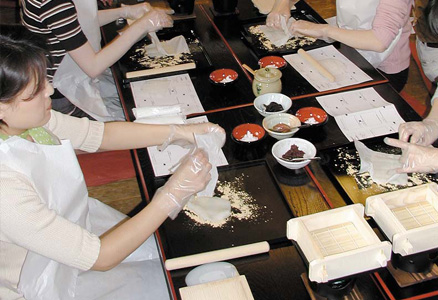
You can buy yatsuhashi all over Kyoto, but my favourite shop (which you'll also find all over Kyoto and at Kyoto station), is Otabe. They've been making these little treats for over 200 years. At the branch near Nishiki koji market (another must-visit in Kyoto), you can also make your own sweets in a little workshop above the shop. At Y600, it's about the same price as a box of yatsuhashi, but you have the satisfaction of making it yourself.

Make your own.

Here's the link to Otabe: http://www.otabe.co.jp/map/shop.html

Monday, October 8, 2012

Pretty things

I am such a sucker for a pretty package.

At least, when it comes to omiyage, what's inside is usually pretty good, too. I've noticed quite a lot of omiyage packaging has gone kind of Taisho-era recently. I remember years ago in Sydney, I saw an exhibition called "Taisho Chic" or something. It was all about the Moga - Modern Girls - with Louise Brooks style bobs, who smoked cigarettes, went to cafes and listened to Jazz. Yes, Japan had flappers too. Like England's Edwardian era, Taisho was quite short (1912 - 1926), but it was a time of creativity and democracy, which unfortunately got taken over by militarism and... well, a lot of big problems that are still festering today.

Anyway, what's important here, is that it inspired some lovely Deco style design. Sometimes, you can still find examples Taisho-era architecture, though they're rare. Kawagoe has a nice mix of Meiji-style, Taisho and early Showa buildings. Tokyo's Imperial Hotel, by Frank Lloyd Wright, even survived (but was damaged in) the Great Kanto Earthquake of 1923 and WWII. Part of it has now been reassembled in Meiji Mura near Nagoya. I hope I can see it there one day. The Old Imperial Bar in Tokyo, while not original, is in the style of the time. I'm always on the lookout for Taisho-era or at least Taisho-style places.
"Tipsy" by Kobayakawa Kiyoshi

Ok, so on to the food! First up, Shiseido Parlour. Originally a soda fountain attached to the Shiseido Pharmacy in 1902, it became a cafe and purveyor of sweets and oddly, one of the first places to serve western-style dishes like croquettes (korroke). So it's 110 years old this year - as good an excuse as any to visit. The famous cinnabar red building in Ginza houses the sweets on the ground floor, and a cafe, restaurant and function spaces upstairs.

This is a limited edition for Autumn: chestnut flavoured cheese cake. The package is really lovely; a mix of gloss and matte black, and though you can't really see it in the photo, the chestnuts are printed in bronze. The use of the branches to frame the name reminds me of those Arts & Crafts style houses in California. Then inside, you get three miniature cheese cakes, which are really light and 'cakey'. Inside, you'll find smooth, sweet chestnut paste. The flavours work well together. They smell amazing, too - surprisingly 'home made'. They demand strong coffee. About 650Yen for 3 (you can get bigger boxes, but there's that temptation to eat them all and not share!)


Must have been a very expensive printing job - you can't really see here, but it's a mix of matte and gloss black, plus metallic.
Three little boxes inside and three exquisite cheese cakes.

Next, the beautiful simplicity of Higashiya. If you've been to the Higashiya cafe in Ginza (in the Pola Building), you'll know they make an art form of simplicity.

This is the entrance

Inside the cafe

Very simple - the most delicious shiomusubi (all I could afford that day, actually!) and some yuzu green tea.

If you can't get to their cafe, try "Higashiyaman" in Aoyama - just around the corner from Issey Miyake - and you can get fresh sweets to take away. This tin, in black and white, mirrors the brand's logo. Inside, you'll find delicate, crispy rice treats called okoshi. These ones are flavoured with ginger.

It's the kind of tin you'll keep for a long time after the sweets are finished.


The shopping bag.

Next, we detour to Hokkaido on our packaging tour, and a little earlier - to the Meiji era. I had heard of the Sapporo Agricultural College before - apparently in the 1880s they had one of the most successful English programs, using language immersion. It became Hokkaido University in 1918, but the Agricultural part still functions as a faculty. And they make amazing cookies! These are light, crispy, buttery shortbread cookies. Well, actually, they don't make the cookies themselves. A Sapporo sweets company called Kinotoya make these "just like grandma's but fancier" cookies, for the university. They started making them in 2005, and inside the box, you'll find the phrase "Boys be ambitious" (nearly typed ambiguous, which might be more appropriate these days). It's the famous catch phrase of 1880s Hokkaido University professor Dr William Clark. It's nice to know that some of the profits from the cookies will go to the university's greenery program.

Retro design, based on the original logo of the University.

And finally, something quite new, but in the spirit of the era. This is another limited seasonal design, using a motif of ginko leaves. Wa.bi.sa is an offshoot of confectioner Yoku Moku (you have to visit their amazing "Blue Brick Lounge" in Aoyama - not just sweets! It's very ladies-who-lunch). Anyway, the company is famous for its light, European-style chocolates and biscuits. But what's interesting in a random way, is the name Yoku Moku comes from the Swedish town of Jokkmokk in northern Sweden. Wa.bi.sa (from wabisabi meaning refinement and simplicity in that very zen Japanese way), is their younger, funkier brand, combining traditional Japanese flavours with modern design. I like the transitions of colours on this package, with stylised ginko leaves. Inside, the cookies - a kind of 'karinto' or fried cookie - are green tea flavour and shaped like sakura flowers.


This is what the cookies inside look like - minus the ribbons.


Friday, September 7, 2012

Wakayama 和歌山

Get out of town

Last week, we took a late summer holiday in Katsuura, Wakayama prefecture. It’s near the border with Mie and close to Nara and the whole area is rich with history – you’ve got Ise Jingu shrine in Mie, where the sun goddess Amaterasu, the legendary ancestor of the Japanese royal family is enshrined. Then there’s the city of Nara, which was the capital of Japan from 710AD and then you have Nachi no Taki, or Nachi waterfall, which predates Shinto as a place of worship. Then if you head west into Wakayama, you reach Koyasan, one of the most sacred places for Japanese Buddhism. Basically, the whole Kii pensinsular is one big World Heritage site!

Aside from the history, the area is really beautiful. The densely forested mountains run down towards the sea and the bays are dotted with little islands. In forests full of huge cedar and camphor trees, I felt like I was in the forests of the Ghibli movie, “Mononoke Hime” (although the movie’s forests were apparently inspired by Yakushima, in Kyushu). Katsuura is also famous for hot springs; a perfect place for a short break!

Nachi no Taki

Kumano Nachi

You can dress up like a Heian era pilgrim

Kumano Nachi Taisha

The stone toro make handy frames for the waterfall


But we’re here for meibutsu and omiyage. And there’s plenty! The great thing about staying in a Japanese style hotel, is the kaiseki ryouri, composed of local specialties. Course after course is served up in the comfort of your room. We had local tuna sashimi; Matsusaka wagyu beef from nearby Mie – one of the three “top brands” of Japanese beef; and wakayama plums – both pickled as umeboshi and made into umeshu wine. One night, dessert was a simple chilled mikan (mandarin), another Wakayama specialty, and sweets made of kinkan (kumquat).

The restaurants around Kii-katsuura station offer a crazy variety of different tuna dishes. I tried maguro katsu, essentially a crumbed and fried tuna steak, which was delicious and meaty, but I wished it had been left a little pink in the middle.

Maguro katsu

Sanma sushi

Mehari sushi

The best meibutsu we tried was also the simplest: sanma sushi and mehari sushi. Sanma (pacific saury), is lightly pickled with salt and vinegar; a little similar to saba sushi, but the taste is lighter. I think there was a little yuzu in the pickling vinegar – there was a slight citrus tang. The other specialty, mehari sushi, looks deceptively simple. It’s a big rice ball, wrapped in salted mustard greens. The name “mehari” apparently comes from the way you have to open your eyes wide when you cram one in your mouth. My husband said hopefully, “oh, maybe you could try making these at home!” so I asked the lady selling mehari sushi bento what kind of leaves she used. She told me it was takana, a kind of mustard leaf. But the hard part is in preparing the leaves – they’re sun-dried and salted, then washed and squeezed and the tough stalk cut out. The stalk can be diced, mixed with a little soy sauce and mixed with the rice if you want. The leaves are also dipped in soy sauce, then wrapped around the rice. Leave them for a few hours to let the flavour soak into the rice. Delicious! I think I need to make a trip to the Wakayama store near Yurakucho station to look for pre-prepared takana leaves. 

Ume icecream

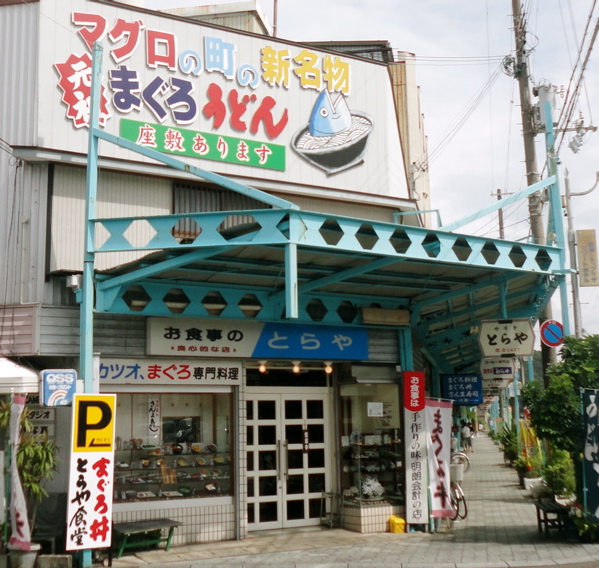
Around Kii-Katsuura. Maguro udon looks interesting!

The very busy roundabout!

If you like sweets, try the local  kuro ame – black sugar candy and kuromitsu – brown sugar syrup (kuromitsu icecream is delicious! I also recommend the ume, plum soft serve icecream near Nachi Falls – it’s just slightly sour like umeboshi: really refreshing!). Citrus fruits are a specialty of Wakayama – not just mikan, but dekopon, yuzu, kinkan, hassaku and jabara. We found a little fruit shop near the station offering “sherbet” made from various citrus fruits. Perched at the plastic picnic table out the front, eating dekopon sorbet while watching the passing parade (no cars, one old lady with a dog, one fisherman in rubber boots) on the very sleepy Showa street, was a very relaxing way to kill time before our train home.

You’ll find a lot of things carved out of black stone around the Nachi area, and almost every home and hotel has a huge chunk of black stone in the garden or entrance. It turns gorgeously glossy in the rain. We have one at home too, a gift from a relative from years ago. Now I know where it came from! I bought a little daruma made of the stone, but I was really looking for a good three legged crow, called “Yatagarasu”. You see the crow motif all over the area – from the Shinto shrines to the local bus station. Apparently, the crow was a messenger of the gods, and a good navigator. No one seems to know why he has three legs.

Had to buy these Kumano Sanzan black rusk sweets made with kuro ame, just for the stylised crow wrapping!

Kumano Sanzan Black Rusk was launched this year - it's made by celebrity confectioner Hironobu Tsujiguchi. Here he is with a black stone, three legged crow.

Inside, they look terribly burnt, but they're tasty and very crunchy.

A refreshing can of ume & honey drink

Mikan caramels. Yummy!

Getting there: The trains and major roads wrap around the coast, so it can take hours to get around Wakayama. We took a train from Nagoya, the “Wide View Nanki”, an express train which takes almost four hours, but the scenery was beautiful. It’s a diesel engine train, so it sounds like a tractor is driving you there! Getting to the shrines is also pretty easy – there are buses from Kii-Katsuura station up to Nachi falls (you can also get off halfway up the hill and walk up the historic Daimon Zaka, a beautiful, paved forest path for pilgrims – takes around 30 mins, but a LOT of stairs). If you want to visit Hongu shrine, Kamikura shrine (built under a huge rock) and Doro gorge, you can take buses from Shingu station. If you want to spend most of your time on the other side of Wakayama and Koyasan, it’s probably better to take a train from Osaka.

Thursday, August 30, 2012

Specially selected

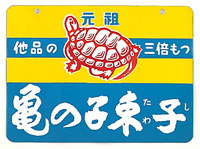
Kamenoko Tawashi


Getting away from food for the moment, perhaps my earliest encounter with a Japanese "meibutsu", is a very ordinary thing. It's a humble pot scrubber with a tortoise logo. Kamenoko Tawashi - literally "young tortoise scourer" has been around for over 100 years, but I first heard of it through the awesome Osaka band, Shonen Knife. See, I'm a true child of the '90s. Their song "Tortoise brand pot cleaner, specially selected pot cleaner, the best pot cleaner in the world is specially selected tortoise brand..." is so inane, but it stuck in my head. So when I saw the real thing, I had to get it. It's great that such an ordinary item can take me back to those days of Stone's Ginger Wine, The Big Day Out and the old Century Tavern on George & Liverpool Sts in Sydney. And at only 315 yen it would make a very cheap souvenir! It's wonderful in its simplicity - the bristles, made of coconut fibre, are finer and more flexible than cheaper versions, it's bound with rope and finished off with a wire hanger. The packaging  hasn't changed much in about 100 years, except it's plastic now. It can't be improved. It just is, the best pot cleaner in the world.

The packaging 

It does what it says on the tin.


Here's a link to the company's website: kamenoko-tawashi. They're based near Itabashi Tokyo, so you could say this is a meibutsu of North Tokyo. If you want to hear the Shonen Knife song (the English version; there's also an original Japanese version on the Burning Farm EP), here it is: Shonen Knife Let's Knife

Earlier packaging, from the company website.

They now also make a questionable range of 'cute' animals. I think I'll pass.

The band that started it all.


Wednesday, August 22, 2012

Ikameshi

The full squid

One of the things I love about train stations in Japan, is they often have promotions by far-flung regions to promote their cuisine and attractions. This week, my local station has a stall from Morimachi, near Hakodate, in Hokkaido. I've always wanted to visit Hakodate, but I had never heard of Morimachi.

Looking at pictures, it doesn't seem to have a whole lot to offer, but it's on Uchiura Bay, with the twin peaks of Mt Komagatake behind it (come to think of it, the town does look quite a bit like the  "Twin Peaks"of David Lynch's imagination. I wonder if they have a Log Lady?).

The main street

Mt Komagatake


But wait, it does have one very special claim to fame: Ikameshi; whole squid, stuffed with rice and simmered in a sweet soy sauce. Apparently, it was invented in 1941 and became a popular bento for people passing through Hakodate on the train.

I had never tried it, but my husband had been waxing nostalgic about ikameshi recently, and asked me if I knew how to make it. In theory, yes... I've made the Italian version, calamari ripieni, with lots of garlic and tomato, but stuffing small squid with mochi rice seemed a bit fiddly and the combination of soy sauce and hot squid flesh makes an overpowering aroma when cooking, which has always put me off. However, if you want an easy guide to making ikameshi, I recommend "Cooking With Dog" - our host dog, Francis, wears a very jaunty green hat in this one! Here's a link to the video: Cooking with Dog Ikameshi

So, if you don't have the patience for cleaning and stuffing squid, just buy them! These ikameshi cost Y500 for two, which was plenty for 2 people with a few side dishes.

On first inspection, they didn't look very appetising, but after heating (you can put them in the microwave for a minute) and slicing into 1cm thick pieces, they were pretty tasty. I still prefer the Italian version, but I might try making ikameshi some time.

It even says "Morimachi meisan" - Morimachi local specialty; in case you weren't sure.

They don't look so appetising like this...

Sliced up: much better. They were firm, but not chewy; just right.

On the company's website you can buy funky ikameshi key chains. Hope they don't smell like ikameshi!


Wednesday, August 1, 2012

Nice package!

Osaka

It's been too hot to travel much recently, so I cheated, and visited the Kotsu Kaikan building in front of Yurakucho station. It has a bunch of shops dedicated to different regions of Japan. The biggest is the Hokkaido shop, which has a very popular Hokkaido Soft Cream stand, but I followed the sweet scent of barbecue sauce and found the Osaka shop, where you can buy freshly made okonomiyaki and takoyaki. I've been to Osaka a few times, and it has a great Showa-era atmosphere, especially in the area around Dotombori. You've probably seen the famous Glico neon sign, Kuidaore Taro-kun (the slightly spooky clown fellow with a drum), and the giant crab, not to mention Osaka's retro Tsutenkaku tower.

Retro Osaka

Osaka is famous for its food ("Kuidaore" basically means "live to eat"), but today, it was the packaging that really got my attention. First up, we have Taro-kun starring in his own dessert: "Cui-daore Taro Pudding". The packaging design reminds me of French illustrator Alain Gree's work - very cute, 1960s style. Inside, you'll find 3 rather small puddings (basically creme caramel), packaged with Taro-kun's stripy hat and his face, each with a different expression. You also get a sachet of caramel sauce and a sachet of yummy, crunchy toffee to approximate the experience of eating creme brulee. At Y1,050 it's a bit expensive (the puddings are seriously small!), but they'd make a great gift for a design fan. They're made by Dojima Sweets. Check out the website for a very cute animation of the puddings: http://www.tarofoods.com/


Inside: the spooky face contains instructions, the sauce and the crunch.

I now have 3 very small hats, about the right size to perch on a cat's head.


The next item is Marufuku Coffee, from Osaka Sennichimae. The coffee shop has been around since 1934, and you can visit the original shop, just near Nambu station. They claim to have a "secret brewing method", but it's basically a nice, rich, drip coffee. I'm not sure why, but the Kansai area seems to be really good for coffee. Kyoto also has great coffee brands like Ogawa and Inoda coffee. If anyone knows about the history of Kansai's coffee culture, I'd love to know! I think I need to do another trip to Kyoto sometime, just to check out all the awesome cafes. Marufuku Coffee has a great logo - like the coffee shop, it seems unchanged since the 1930s. You can find some nice vintage images and a list of all the Marufuku branches on their website: http://www.marufukucoffeeten.com/

The original staff

Founder Sadao Ibuki

The original shop, which hasn't really changed

Marufuku ground coffee, perfect for filters.

Finally, I had to pick up a bottle of this "Daikoku Sauce". You can get sauce for okonomiyaki and takoyaki, but I decided on yakisoba sauce. Daikokuya has been making these rich, piquant, typically Osaka style sauces since 1923. According to their website, they're "obsessed" with sauce! It's a popular brand at a lot of local restaurants, too. Yes, it's delicious, and inexpensive (like most things in Osaka), but I couldn't resist the trademark, which is Daikoku, the jolly god of wealth and also god of the kitchen. Osaka folks are renowned for their skills at making money and love of food, so it seems a very appropriate symbol. Here is the Daikokuya website: http://www.kk-daikokuya.co.jp/h/

Rich, dark, sweet and salty... it's Osaka in a bottle!